

PORTRAITS
Henri Dutilleux Sylviane Falcinelli Marc Blanchet Côme Jocteur-Monrozier Radios – Interviews – Seminars – Documentaries
Henri Dutilleux
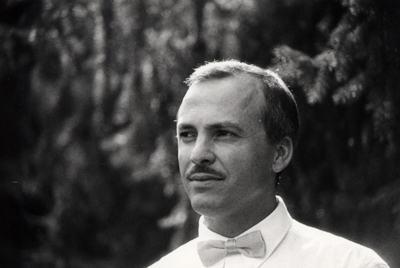
« I have always liked the ease with which Patrick Burgan manages to mould his style by adapting it to the kind of works he decides to undertake. The recent production of Peter Pan or the real story of Wendy Moira Angela Darling reveals a new aspect of his talents in the field of opera inspired by the world of childhood ».
(2006, regarding the opera Peter Pan)
« The full-length version seduced me by the fit of light, the liveliness of the instrumental language »
(2004, regarding Spheres for large orchestra)
« I was indeed very moved by your intention to dedicate this work to me. And now, I’m glad to tell you that I love the construction, the spirit, the musical material, and particularly this ease (in the best sense of the word, it would be better to say this freedom) with whom you realize your subject, as in others of your works actually.
The link with Baudelaire, by the evocation of the poem « A une passante », who always fascinated me, also moves me a lot »
(1997, regarding Un éclair…puis la nuit ! for 15 instruments)
« I have always liked the ease with which Patrick Burgan manages to mould his style by adapting it to the kind of works he decides to undertake »
Henri Dutilleux
Patrick Burgan, or the Rediscovered Voice by Sylviane Falcinelli
Faced with a dehumanized and depoeticized world, faced with the withdrawal of an audience worn down by several decades of intellectual and mechanistic aridity in the field of so-called contemporary music, Patrick Burgan raises his voice—highly individual without being polemical—to remind us that a spontaneously contemporary expression can embody the timeless values of artistic inspiration.
In this sense, he persistently devotes himself to what is most inalienably constitutive of the human being: the voice itself, the voice as a vehicle for poetic imagination and spiritual dimension.
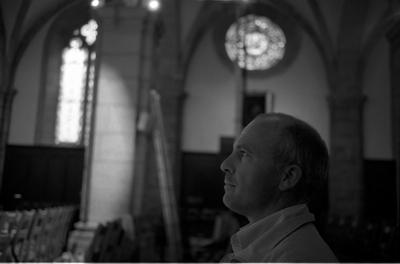
Patrick Burgan (born by chance in Grenoble in 1960, but Pyrénéen by roots and at heart) has already built a catalogue encompassing a wide variety of instrumental, orchestral, and vocal forms, and it would be mistaken to confine him to any single field of expression. Yet he himself acknowledges (as does the attentive listener) that his first work for a cappella vocal ensemble—La Puerta de la Luz (1) (1994), set to poems by Antonio Machado and Federico García Lorca—marked a decisive turning point in his writing, later influencing his orchestral and instrumental work. Indeed, instruments in his music readily take on the role of characters: already in Jeux de femmes (1989, based on Verlaine’s erotic poems), the soprano entwined with a flute; his saxophone quartet (Miniatures, 1997) portrays moods and psychological states; Le Lac (1999, based on Lamartine’s poem)—a sumptuous score in which the soprano voice is draped in a shimmering orchestral fabric—opens with a long cello solo that unfolds in the same flow as a vocal line.
But from another perspective, he has explored the full “orchestration” that can be drawn from an ensemble of human voices. For example, Le plaisir originel (1999, based on a text by Edmond Haraucourt), for seven a cappella solo voices, focuses on the various ways of creating movement within stillness; or, to put it differently, the stillness in motion of the collective self-generates the elasticity of its fluctuations around poles from which the impulse of a given soloist emerges. Over the course of such an imposing score (24 minutes), highly varied declamatory styles are employed, without excluding historical references (from the Renaissance to Debussy), yet the challenge lies in ensuring that no rupture of atmosphere compromises the unity of the initial premise. In other cases, Patrick Burgan knows how to restore the dramaturgy of a poem by exploiting the emotional impact, the sensitive charge of the various modes of vocal emission and expression, whether of the ensemble or its soloists (La Puerta de la Luz was a first masterful example, followed by many others). Yet he refuses to instrumentalize or distort the human voice, and to dismantle the work of the poet, to whom he accords a respect that has become rare. For our composer attaches the utmost importance to the choice of poems he sets to music. The love of fine texts, and the emotion that springs from them, is a powerful driving force behind his inspiration. In this respect, he stands at the opposite extreme of an attitude fashionable in the previous generation, which consisted in treating poetry merely as a source of phonemes contributing to an acoustic field of exploration. In his work, on the contrary, the sensibility captured by the poet in verse must irrigate the music, and the semantic power conveyed by the writer nourishes his musical gesture.
The solo voice proves just as supple in adapting to the fluctuations of poetic phrasing when the atmosphere is shaped by instrumental accompaniment: a masterpiece of emotion, Les étrennes des orphelins (2000, after Rimbaud), sets women’s voices within the evanescent stillness of an instrumentation whose reduced forces—limited to nine parts—do not prevent a mysterious shimmering of unreal colors.
Mystery again—the magic of the timeless—such as Patrick Burgan knows how to create in order to transport us into the spheres of the spiritual. To achieve this, there is no need for a “return to…” nor for the hazy medievalism promoted by certain advocates of a “postmodernism” (where such semantic absurdity finds refuge!) already surpassed. Timeless does not mean backward-looking, and it is as a composer of today that Patrick Burgan turns to the great texts of the Latin liturgy. Another of his masterpieces, Audi Coelum (1998), proceeds through layers of different types of vocal and organ writing, from melismatic cantilena to polyphony, from blended sonorities in suspension to the unreal swirling of hypnotic sequences; at the end, suspended time escapes into eternity. The listener emerges imbued with a deep peace, conducive to contemplation.
Sacred inspiration extends beyond the choral domain, even if our composer returns to it periodically: it is through orchestra alone that he chose to illustrate Les Sept dernières paroles du Christ (1996); the concision of the discourse distills the quintessence of the drama into images that speak directly to our consciousness. Marian liturgy, which holds a privileged place for Patrick Burgan, follows the paths of the solo organ: Ex Maria Virgine (1992) plays with echoes of unusual sonorities reverberating beneath vaulted spaces. To return to sacred art today implies questioning the very meaning of the creative act—an act of faith, if ever there was one—in a mercantile world where the gratuitous nature of a vocation devoted to translating and transmitting the forms of an inner ideal appears either as an indecent provocation or as a saving illumination.
Here we touch upon Patrick Burgan’s conception of art and life: he likes to speak of the compositional process in terms of “biological development through cell division,” of “energy being released”; he rehabilitates expression as the “unveiling of the human soul.” In his view of a work in the process of being born—sound matter shaped by the creator’s ideal—as well as of the fusion of soul and matter that constitutes the human being, he rejects any ontological separation, any artificial compartmentalization, which leads him to abolish distinctions between secular and sacred art. Just as the time of earthly life is inscribed between a before and an after, a work represents the “setting into vibration,” through the composer’s technical means, of a “fundamental energy that pre-exists”; the composer receives it, gives it form through his artistic individuality, and in turn transmits it to other human beings who will listen to it. Yet he never loses sight of the fact that the artist, aspiring to give a face to the Beauty he feels within himself, touches an Absolute that radiates through him, and thereby touches something of the order of the sacred.
Thus, the entirety of Patrick Burgan’s work must be reread from the perspective of a profound unity, in which each new stone added to the edifice completes and illuminates the architecture of the previous ones. This unity applies to thought, carried along by the flow of life and encompassing all the states of our journey—whether it is moved by the lament of an unborn child (the deeply moving final poem of La Puerta de la Luz), overwhelmed by Eros, meditating at the foot of Christ’s Cross, or confronting the Requiem (a work scheduled for premiere in 2004). It also applies to the means of expression which, without ostentation, shape a perfectly identifiable language of great flexibility: the suppleness animating both the melodic line and the evolution of sound masses owes much to his sustained work with voices, yet ultimately mirrors the human gesture—whether the gesture of love or of prayer.
This ductility of language reflects the choice of music as the form of expression least likely to freeze the momentum of feelings or sensations, and its complex interweaving with the abstract dimension of thought. Yet this implies the articulation of a discourse constructed with as much coherence as a narrative (another notion dear to our musician), in order to organize the transmission of meaning to the listener. Patrick Burgan’s attitude is therefore one of listening and openness to all that touches the inner being; the creative act that results can only be deeply felt and free of intellectualizing artifice, even if perfectly controlled. Hence this clearly expressed conviction:
“A composer who seeks originality at all costs is on the wrong path. A composer does not have to seek originality: it must arise of itself in the realization of his work. The composer simply seeks a perfect adequation between the music he hears within himself and the material that will be set into vibration. I believe that the great problem of twentieth-century music was this search for originality for its own sake. Either it is there or it is not, but that is not the composer’s problem.”
Sylviane Falcinelli (2)
(1) The vocal music festival of the Abbey of Silvacane titled its 2003 edition “Gate of Light,” in reference to Patrick Burgan’s work, which was performed there on August 15 of that year by the ensemble Musicatreize under the direction of Roland Hayrabedian. La Puerta de la Luz is recorded by this ensemble on an MFA Radio-France disc.
(2) The musicologist Sylviane Falcinelli devoted a radio program to the composer Patrick Burgan on June 27, 2003, on Radio Suisse Romande, and is currently preparing a book of interviews and analysis of his works
“His chosen means of expression reveal the human soul”
Sylviane Falcinelli
My Collaborations with Patrick Burgan by Marc Blanchet
A poet’s writing takes on an entirely different resonance through collaboration with a composer. Something becomes more complex through musical writing (and singing), and at the same time a kind of lightness emerges in the language. One network of correspondences gives way to another. Figures, obsessions, images take on new contours, if not a depth that is not secondary but entirely new—a kind of rebirth through another artistic channel. These figures, these obsessions, these images might appear unrecognizable to me. Patrick Burgan’s music carries them toward another slope, instilling in them new stakes.
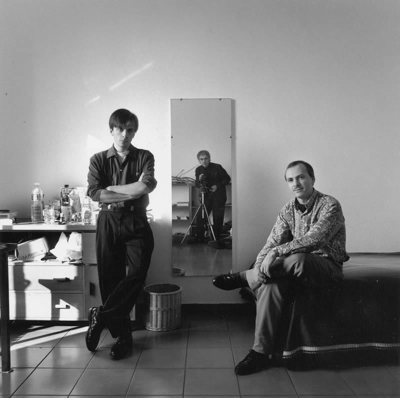
“”With the poet Marc Blanchet and the photographer Max Armengaud at the Casa of Velazquez in 1993 (photo Max Armengaud)””
Patrick Burgan affirms the depth of song in the face of the century’s irony, multiplies sensations in the face of common sense, and does not conceal an authentic intoxication, outside the usual forms and vessels. What we share is that we are difficult to “catalogue.” If the lyricism of our creations is in direct correspondence with a deep nature, we also strive to refine it, to challenge it, to bring out a complexity coupled with a sincere sense of pleasure which, if it does not disturb, perhaps charms, since it does not seek to convince. In Patrick Burgan, I appreciate the absence of any didacticism. If there is a discourse at work, it is the one that allows the work to achieve its perfect curve, to recount a universe of pain, sensuality, or reverie, without adorning itself with the effects of an apparent modernity, without resorting to temporary philosophies, and above all serving only the very richness of the music—precisely that which will reveal the originality of this discourse.
Thus all of Patrick Burgan’s music—this gift extends beyond the vocal music with which I have had the pleasure of collaborating—asserts itself without the slightest demonstration. However, this statement must be qualified: the discourse is indeed there, its development visible insofar as it is shared. But the composer does not drown his inspiration in the mere assertion of a discourse. Patrick Burgan’s music unfolds in ramifications and abysses. It certainly soars, but it also reveals the pain beneath its flanks, counteracts the melodic marvels of its unfolding to point, with a trembling finger, to surges, fevers, loops. It is in this tension, and thanks to this questioning, that it gains all its nobility.
Thus I have seen Patrick Burgan at work in his reading of my own poems, seeking to bring together the sum of his sensations and instincts with mine, in order to give rise to the unexpected of an exchange, in order to give the poem—through the musician’s perception of it in his music—a depth that may already exist in the silent mental act of reading. Patrick Burgan’s relationship to the text is to feel all aspects of a literary writing, and not to praise technique at the expense of sensation. In this way, he acts so that his music, in turn, acts upon the listener—carrying them, rooting them, or exiling them to regions where both word and music would be the visible part of an immemorial silence—and surely the finest part of a dream of a high sensuality finally restored to humankind.
Marc Blanchet
The poet Marc Blanchet is the author of the libretto “La source des images ou Narcisse exaucé”, a lyrical tale for one actor, 12 singers, and instrumental ensemble, which was premiered in 2000 by the ensemble Musicatreize. He also wrote, at the composer’s request, the three poems of “Soleils” for equal-voice choir, premiered by the Mikrokosmos choir in 1996. Moreover, his poetry collections (“Poèmes de la Chartreuse,” “Sanctuaires,” etc.) are a source from which Patrick Burgan draws with particular fondness.
“Patrick Burgan affirms the depth of song in the face of the century’s irony.”
Marc Blanchet
Patrick Burgan, Composer by Côme Jocteur-Monrozier
“At heart, I am a romantic.”
What first strikes one when encountering Patrick Burgan is a sense of wonder that time has never managed to dull. His music resembles him: dreamlike yet shadowed with unease, sincere to the point of disarming, sweeping audiences and performers alike beyond aesthetic disputes through the sheer power of its imagination. With a catalogue of nearly a hundred works—ranging from chamber pieces to expansive symphonic frescos and opera—Patrick Burgan cultivates a deeply lyrical sonic universe, enamored of timbres, colors, and contrasts.
“As a child needs to draw, I needed to write music.”
From his youth in a small town at the foot of the Pyrenees, Burgan has retained something of the autodidact. Even today, the inner world he built during long solitary hours spent reading or dreaming at the piano lies at the core of his musical identity. But when, at seventeen, he entered the Conservatory of Toulouse—with the sketch of a first symphony already completed—he discovered the vast terrain he still needed to explore to truly shape his imagination.
Thus began years of intense study: first rewarded with a music agrégation, then carried further at the Paris Conservatory, where he studied with Ivo Malec, Gérard Grisey, and Betsy Jolas.
“I deliberately chose Ivo Malec, the most experimental of them, a pioneer of electroacoustic music, because I needed to discover everything before finding my own language.”
A dialogue between madness and architecture
“Each work is born from an initial cell—a tiny sonic impulse that divides, reproduces, and eventually becomes a complete structure, almost biologically.”
From this germ emerges a score built on the tension between two forces: a raw, almost instinctive energy, and an architectural sense that shapes a narrative, developing form and meaning together. This confrontation passes through the composer’s body itself: “I end up shouting, yelling, because this explosive force needs to break out.”
The resulting music does not reject tonality; instead, it bends it to the demands of a singular, deeply lyrical expression. “The music I write is romantic in the sense of the dreamlike—of unrestrained exaltation and a taste for the extreme.”
“If Peter Pan never grows old, it is because he is dead.”
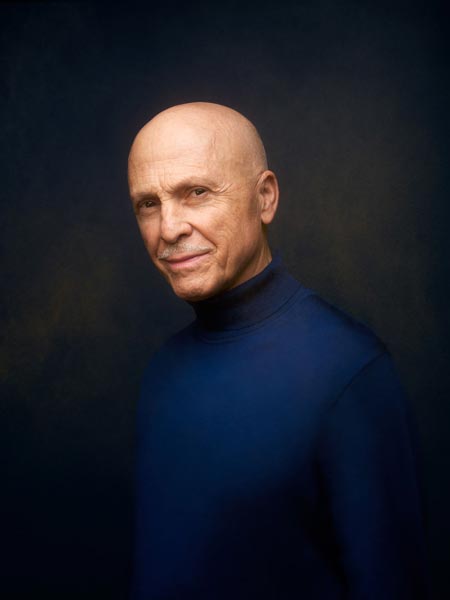
As early as La puerta de la Luz (1994), composed upon his return from the Casa de Velázquez, one finds the child imagined by Federico García Lorca—unborn, demanding answers from the living. This childlike presence, with its unguarded joy and anxious melancholy, has never left Patrick Burgan; it resonates through his entire oeuvre. “I have a kind of obsession with purity: childhood is what has not yet been tarnished by misery.”
It is hardly surprising, then, that the story of Peter Pan inspired him to compose a highly acclaimed opera, premiered at the Théâtre du Châtelet in 2006. Returning to J. M. Barrie’s original tale, Burgan creates a text and score of striking density, where perspectives and timelines intertwine. “Three worlds intersect: the world of memory and nostalgia, the present of the story, and the dream realm of the lost children.”
A sensuality of sound
The coexistence of childhood and sensuality is only paradoxical in appearance. An undercurrent of eroticism—more mischievous than perverse—runs through Burgan’s works. It is what led him to set to music the erotic poems of Verlaine, Edmond Haraucourt, or the Song of Songs.
“For me, music is first and foremost the sensual pleasure of sound, the vibration that makes your eardrum quiver like an erotic shiver.”
This taste for voluptuousness also appears in his love of the musical line: his devotion to instrumental and vocal writing—demanding yet never violent—explains his appeal among both performers and audiences. His long-standing collaborations with Les Éléments, Musicatreize, Mikrokosmos, the Méliades vocal quartet, or trombonist Fabrice Millischer (who commissioned from him the monumental Fall of Lucifer) bear witness to this.
Words, music, and the invisible
Though he has approached nearly every musical genre, words often serve as the spark for Burgan’s imagination. “For me, the aim is to retrieve the generative idea within a text—the energy that binds its words together—and transmute it into music.”
His oeuvre draws equally upon Romantic poets (such as Lamartine, whose Le Lac he transformed into a kind of hallucinatory vision), liturgical texts (whose literary fervor he knows how to exalt), and writers like Michel Tournier (whose Vendredi he dreams of setting to music).
For Burgan, a text must above all remain audible and comprehensible—a conviction illustrated by Enigma, his most recent opera, based on a play by Éric-Emmanuel Schmitt. Premiered in Metz and recently reprised at the Opéra de Montréal, the work stages a psychological duel between two tenor voices, exploring the very friction of words—what they reveal and what they conceal.
“Music is pure energy; through it, we sense realities that elude us—hidden truths. Perhaps music is the only form of expression capable of approaching the essence of what is real.”
“Patrick Burgan cultivates a deeply lyrical sonic universe, enamored of timbres, colors, and contrasts.”
Côme Jocteur-Monrozier
Radios – Interviews – Seminars – Documentaries
RADIOS
– Cross interview: Eric-Emmanuel Schmitt – Daniel Kawka – Patrick Burgan
RPL broadcast – 22 november 2022 – Subject : Enigma at Opéra de Metz
-> France-Musique – The contemporary Portrait – by Arnaud Merlin
– > France Musique “Miniatures” – Cécile Gilly
Portrait of Patrick Burgan in 5 broadcasts
- Miniatures 27 avril 2009
- Miniatures 28 avril 2009
- Miniatures 29 avril 2009
- Miniatures 30 avril 2009
- Miniatures 1er mai 2009
– > Patrick Burgan’s Portrait on Canal Académie :
– > “Impulsion” France-Culture’s broadcast, regarding the opera Peter Pan and the theatral aspects of Patrick Burgan’s music :
– > A DO # : broadcast by Dominique Boutel on France Musique, documentary on Peter Pan’s behind the scenes :
INTERVIEWS
– Patrick Burgan Interview about the opera ENIGMA :
– Daniel Kawka interview about the opera ENIGMA :
– > Patrick Burgan’s interview during the tour with Batèches for 11 percussions :
SEMINARS – DOCUMENTARIES
-> Via Lucis (documentary)
-> Cantique des cantiques/Les Spirituelles (documentary)
-> La chute de Lucifer (documentary)
– > Seminar of 18/03/2016 : Patrick Burgan (time in the video : 25′ à 41′) talk about the influences of other musics (populars, medieval, etc.) in his works, and particularly in his lyrical epic “1213-Bataille de Muret” : Clic here
– > “I remenber…” Documentary about the 20th birthday of Festival Toulouse-Les-Orgues, with the wonderful first performance of Audi Coelum (beginning of the doc.) : Clic here